AI solution development differs from traditional custom development from the very beginning. In a conventional software project, a company defines the problem, prepares a brief or specification, and the development team implements clearly defined business logic, tests it, and deploys it to production.
With an AI solution, the system’s behavior is not defined by code alone. The result also depends on the model, the prompt, the available context, the quality of the data, and the way the user formulates a request. This changes not only the technical architecture, but also how AI projects are planned, tested, and operated.
Predictability is another key difference. A traditional application follows explicit rules: if condition A occurs, the system performs action B. With AI, we define the objective, the context, and the boundaries within which the model should operate.
With AI, Defining Functionality Is Not Enough
In traditional custom development, functionality can usually be described quite precisely through user stories and acceptance criteria. The user completes a form, the system validates the data, performs a specific operation, and displays the result.
With AI, a requirement such as “the system should respond to customers” is not enough. You also need to define what a high-quality response looks like and how the system should behave in situations that are not entirely clear.
At the design stage, you therefore need to address questions such as:
- which sources the AI is allowed to use,
- what the response must contain,
- what it must not contain,
- what the system should do when it is uncertain,
- when a request should be handed over to a human,
- what level of error is still acceptable.
It is not enough to know what the AI agent should do. We also need to know how we will determine whether it is doing it well.
AI Should Not Replace Traditional Business Logic
With AI solutions, it can be tempting to move as much decision-making as possible directly into the prompt. This can work very well in a prototype because the system appears flexible and “intelligent.” In production, however, important rules should not be left to the model alone.
Consider a refund request in an online store. AI can understand what the customer is asking for, summarize the reason for the complaint, and suggest the next step. It should not, however, decide financial limits, permissions, or whether the refund should actually be processed. Those rules should remain in the traditional backend, where they are clearly defined and can be controlled.
How Al works in a business process
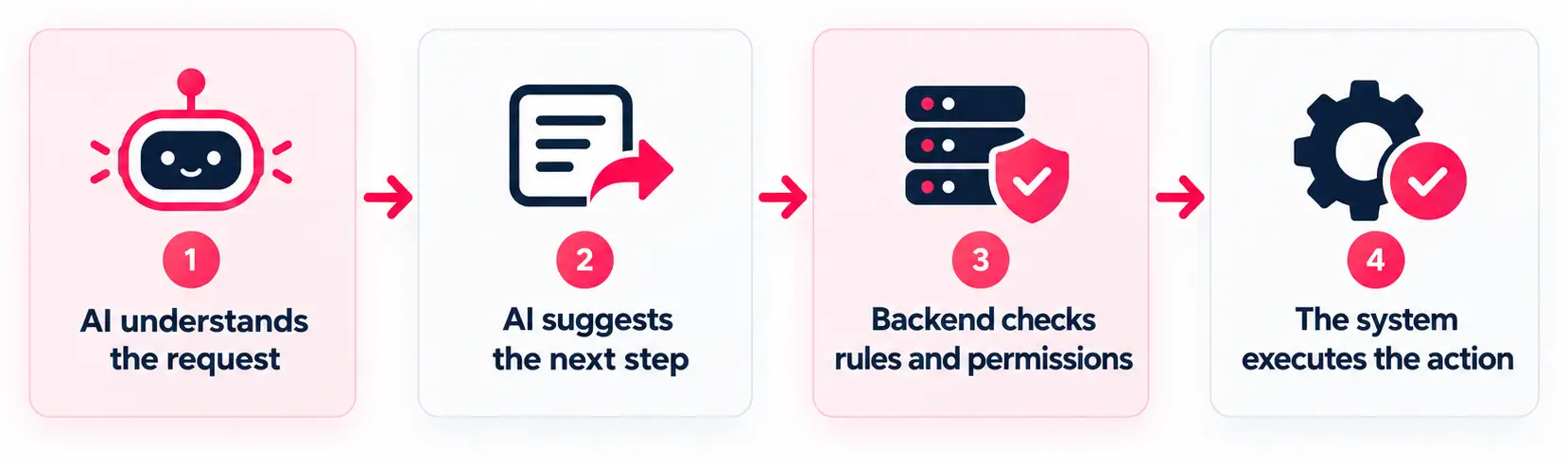
Al helps with interpretation and suggests the next step. Rules and critical actions remain under the control of your system.
AI should therefore be used where it is strongest: working with text, understanding context, and processing unstructured information. Traditional software remains responsible for rules, controls, and critical operations.
AI does not replace existing business logic. Instead, it adds an intelligent layer on top of it, one that can work more effectively with ambiguous inputs and prepare the next step.
Data Directly Influences System Behavior
In a traditional application, data is primarily an input processed by predefined logic. With AI, data also becomes part of what determines how the system behaves.
If AI responds based on internal company documents, the quality of the result depends on whether it finds the right document, whether that document is up to date, whether it conflicts with another source, and whether the user should have access to it in the first place. This is why it is practically impossible to develop an AI solution without addressing topics such as:
- source of truth,
- data quality,
- access rights,
- metadata,
- retrieval,
- data ownership.
The quality of company data is particularly important in RAG solutions. Even a very capable language model will produce poor results if retrieval returns incorrect, incomplete, or outdated sources.
With AI, choosing a better model does not automatically solve the problem. The data often needs to be addressed first.
Testing Is No Longer Just Pass or Fail
Traditional software can be tested against precise expectations. For a specific input, we expect a specific output. With AI, several different answers can all be correct even if they are phrased differently. Testing therefore shifts from checking a single value to evaluating the quality of the system’s overall behavior.
In practice, teams may monitor:
- factual accuracy,
- relevance of the response,
- use of the correct source,
- occurrence of hallucinations,
- correctness of tool calls,
- successful completion of a workflow,
- correct escalation to a human.
For this purpose, evaluation datasets are created using real or representative scenarios. In other words, we do not test an AI solution only to determine whether it works technically. We also need to understand how well it works.
Development Does Not End With Production Deployment
With a traditional application, deployment may be followed by a relatively stable period. If the code and business logic do not change, the system’s behavior generally remains the same.
AI systems are much more dynamic. The model may change, the prompt may change, internal documentation may be updated, the retrieval layer may evolve, or users may start interacting with the system in new ways. Even a small change can affect the quality of the output. That is why it is not enough to monitor service availability, response time, or API error rates. Metrics such as the following are also important:
- accuracy,
- hallucination rate,
- tool success rate,
- escalation rate,
- latency,
- cost per request.
In other words, alongside the technical functionality of the solution, we need to monitor whether it is working correctly, how much it costs to operate, and whether it behaves consistently even in scenarios that did not appear during the pilot phase.
Costs Behave Differently
In custom development, costs typically depend on the scope of development, infrastructure, and operations. With AI, an additional layer is introduced that is much more closely tied to actual system usage. The cost may depend on:
- the number of requests,
- the number of tokens,
- context size,
- the model being used,
- the number of tool calls,
- the complexity of retrieval.
A well-designed AI architecture therefore monitors and optimizes not only the quality of the output, but also the economics of running the solution. Not every task requires the largest and most expensive model. For simpler use cases, a smaller model or traditional code may be more efficient, while more complex scenarios may require a more capable model.
The Security Model Changes as Well
In a traditional application, the user performs operations that developers have explicitly programmed. An AI system, however, can work with unstructured content, interpret a request, and dynamically decide which tool or API to use. This introduces new risks, such as prompt injection, sensitive data leakage, or situations in which the AI is given overly broad permissions.
Security therefore cannot rely on the prompt alone. Critical controls must remain in the application and infrastructure layers.
AI solution security is most often handled through a combination of several measures:
- Least privilege
AI should only have access to the data and operations it genuinely needs. If its task is only to read the status of an order, it should not also have permission to modify or cancel that order.
- Separating read and write operations
Reading data carries less risk than modifying information, sending a payment, or creating an order. Sensitive write operations should therefore go through additional checks.
- Authentication and authorization
AI must not bypass application rules. Through AI, a user should only be able to access data and perform actions they are already authorized to access or perform in the original system.
- Human in the loop
For higher-risk operations, AI can prepare a recommendation, while final approval remains with a human. This typically applies to financial operations, changes to customer data, or legally sensitive decisions.
- Input and output validation
The system controls what enters the model and what comes out of it. This can include format validation, filtering sensitive information, or blocking potentially dangerous instructions.
- Tool allowlists and restricted APIs
An agent should not have unrestricted access to every system. It should only have access to clearly defined tools and operations that it is permitted to use.
- Audit logs and tracing
For important operations, it should be possible to trace which data the model used, what decision it proposed, which tool it called, and what the system subsequently executed.
- Secrets management
API keys, passwords, and tokens should never be included in prompts or made available to the model in readable form. They should be managed separately through secure secret stores and the application layer.
- Isolation and sandboxing
If AI executes code, works with files, or processes external content, these operations are often performed in an isolated environment with restricted permissions.
- Protection against prompt injection
An external document, email, or web page may contain instructions designed to influence the model’s behavior. That is why not all content processed by AI can be trusted automatically.
The key principle is that the model must not become the security authority of the system.
While a Proof of Concept Is Simple, a Production Solution Is More Demanding
A functional AI prototype can be created very quickly. After relatively little setup, a model can answer questions, work with documents, or suggest next steps, and at first glance the solution may seem almost finished.
The difference becomes clear in real-world use. A production solution has to work consistently across different types of inputs, use the correct data, respect user permissions, and handle situations that were not considered during the prototype stage.
When moving into production, teams typically need to address:
- output reliability – how often the system responds correctly and what it does when it is uncertain,
- real-world data – its freshness, quality, and access permissions,
- integrations – connecting to internal systems and executing actions safely,
- error handling and fallback scenarios – for example, escalating to a human or stopping the workflow,
- monitoring and evals – continuously measuring quality after deployment,
- cost and performance – latency, the number of model calls, and the cost of individual operations.
AI Development Has a Different Rhythm
Traditional custom development usually follows a more linear process. It starts with analysis, continues through design, development, and testing, and ends with production deployment. Of course, teams may still return to earlier stages, but the goal is generally to move toward a stable result based on predefined requirements.
AI development is naturally more iterative. It starts with a specific use case and the relevant data, followed by a prototype that is continuously evaluated using evals. Based on the results, the solution is adjusted, tested in a pilot, and then further monitored and optimized after deployment. Development, testing, and improvement overlap much more because the quality of an AI solution depends not only on the code, but also on the model, prompt, data, retrieval, and user behavior.
Traditional custom development vs. Al development
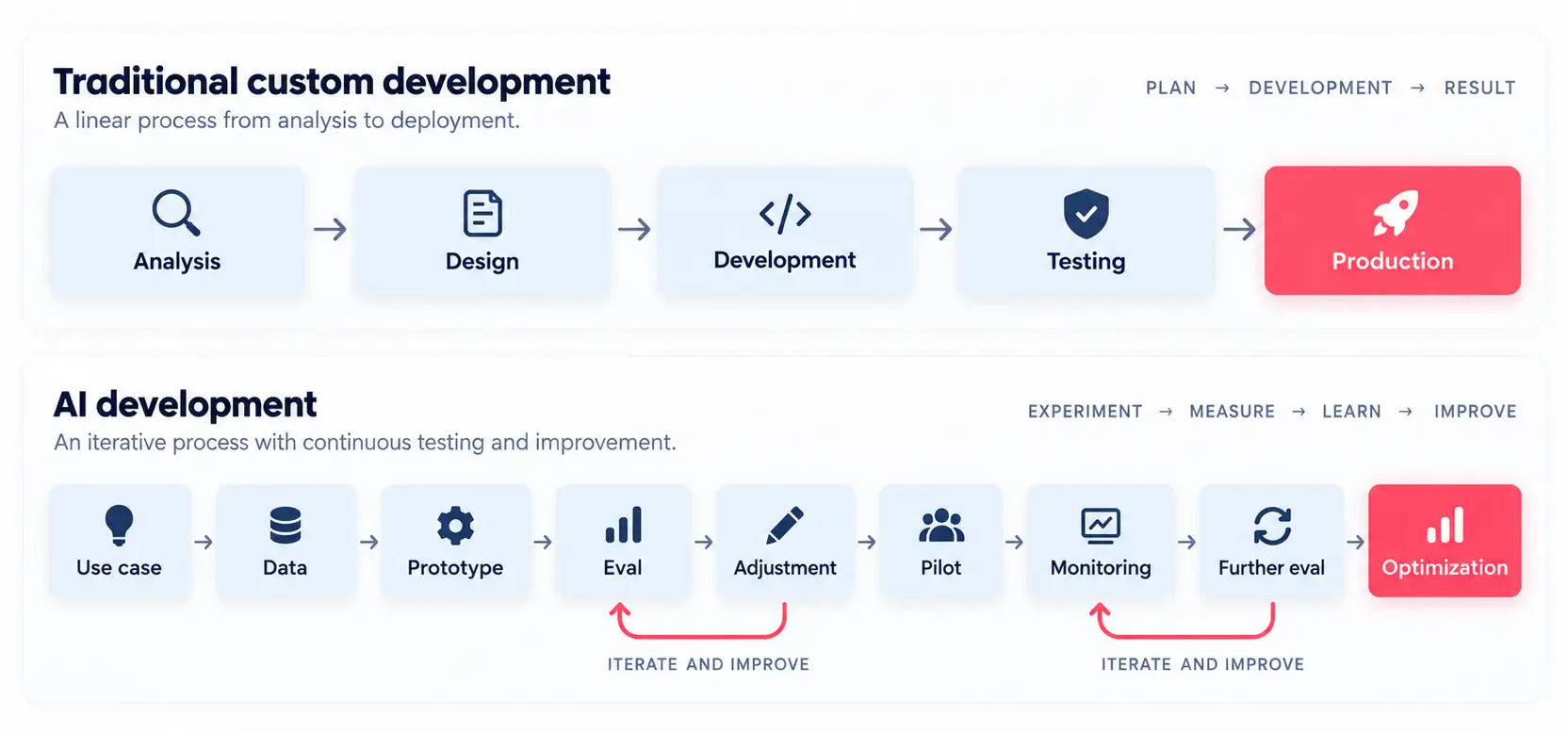
In Al projects, development, testing, and improvement overlap much more than in traditional custom development.
AI solutions are also viewed differently from a cost perspective. This does not automatically mean that they are more expensive, but some of the costs shift from one-time development toward ongoing operations and optimization.
With AI, we therefore monitor not only implementation costs, but also new variables such as cost per request, cost per task, or cost per resolved case. This makes it easier to evaluate whether the solution is actually saving time, reducing manual work, and delivering value compared with the original process.
Are You Considering Your Own AI Solution?
We would be happy to explore where AI can deliver real value, how it can be integrated with your existing systems, and how to design a solution that is ready for production use.
Do you have an AI use case you want to move from idea to reality?
Get in touch with us.