In the previous article, we looked at which data is worth migrating when moving to SAP S/4HANA and why data quality matters more than the transfer itself. But that raises another question: Does all the data a company needs for reporting and decision-making really have to be stored physically in one place?
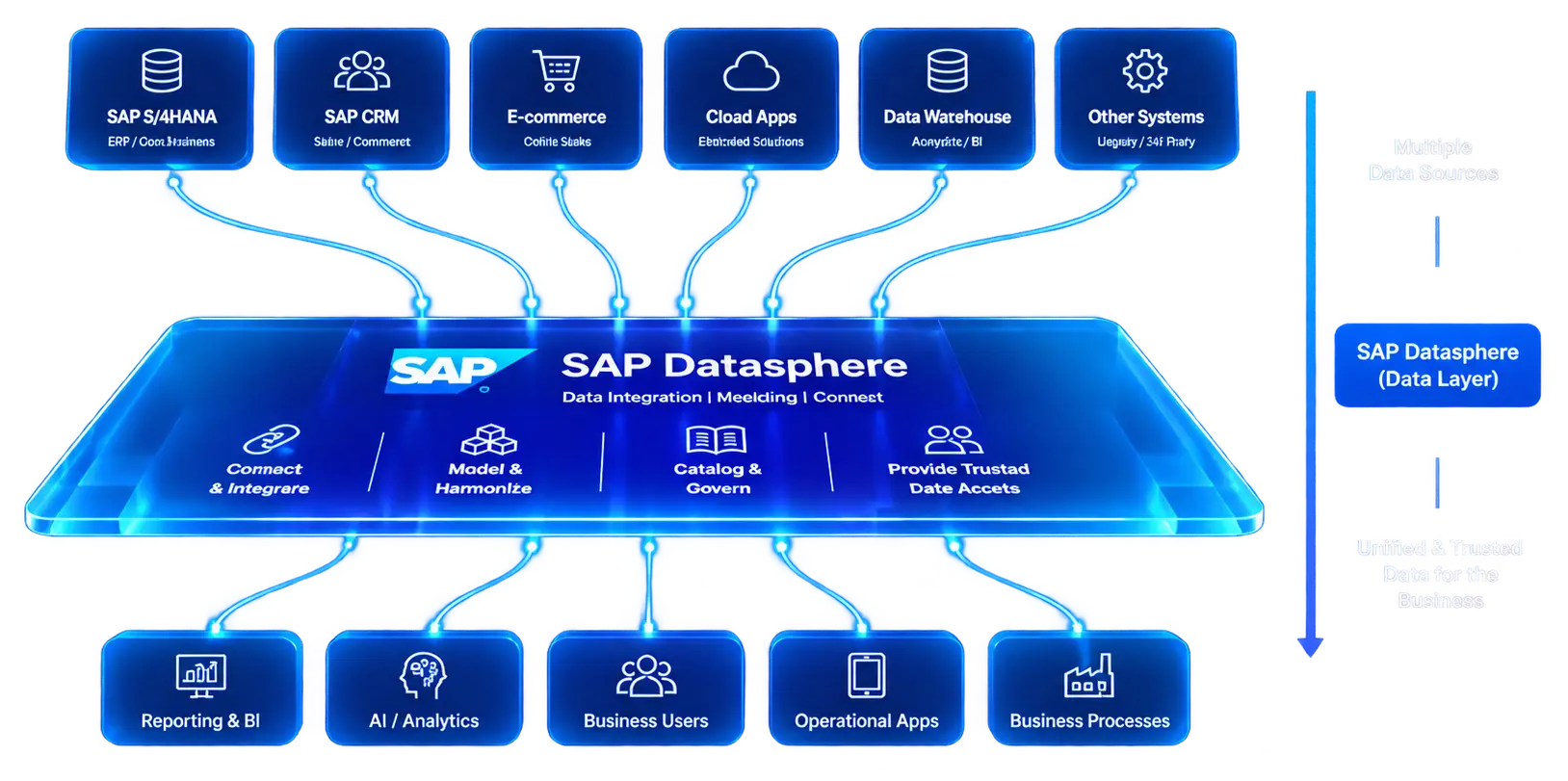
In many companies, that is not the case. Financial data may be in SAP S/4HANA, customer data in a CRM, orders on an e-commerce platform, and other information in a data warehouse or the cloud. Problems do not arise simply because the data is stored in different places. They arise when the company cannot reliably connect it and use it in a shared context. And this is where SAP Datasphere becomes interesting.
What Does SAP Datasphere Actually Do?
SAP Datasphere acts as a common layer between different data sources. That does not mean all data has to be physically moved to one place. Instead, SAP Datasphere creates a connection that allows a company to work with data from different systems as part of a unified whole.
Take a finance department, for example. It may need to compare current data from SAP S/4HANA, market information stored in another system, and the outputs of analytical models used by the data team. A traditional approach would mean first copying everything into a single repository, transforming the data, and only then creating reports.
SAP Datasphere makes it possible to connect, integrate, and model data from both SAP and non-SAP systems so that it can be used within a shared business context. The goal is not to move everything into one repository at all costs, but to choose the right access method based on how the data will be used.
Datasphere in the Context of SAP Business Data Cloud
The idea of connecting data is not entirely new. What is new is that SAP is placing much greater emphasis on this area as part of its broader direction in data and artificial intelligence.
Today, SAP Datasphere is not an isolated product within SAP’s data portfolio. SAP positions it as part of the broader SAP Business Data Cloud environment.
Companies now use a wide range of data tools, including their own data platforms, cloud solutions, and analytics tools outside the SAP ecosystem. SAP is therefore working to connect these worlds and enable companies to work with their data in a more consistent way.
Datasphere is becoming one of the key components of SAP’s broader data strategy, which aims to give companies better visibility into their data, help them manage it more effectively, and make it usable for areas such as artificial intelligence.
Why Should the Business Care?
There is a lot of discussion today around AI, automation, and intelligent functionality in enterprise systems. But all of these technologies share one common requirement: they need high-quality data. If a company does not have accurate, up-to-date, and connected data, even the most advanced AI tools will not solve the problem. Results may be inaccurate, recommendations unreliable, and decision-making may still depend on manual checks.
That is why data quality is becoming an increasingly important topic in the context of Datasphere as well. The aim is to help companies identify issues such as missing information, duplicates, or inconsistencies before they affect reports or business decisions.
In other words, it is not only about connecting data, but also about making sure it can be trusted.
One Click Will Not Solve Your Data Problems
As with any major data transformation, there are challenges.
Large companies in particular often operate in highly complex environments with many systems, years of historical data, and processes that have evolved over time. Moving towards a new data architecture is therefore not something that can be completed in a matter of weeks.
It can be even more complicated for companies that are already in the middle of major SAP projects, such as a migration to S/4HANA. In that situation, changing the ERP system while also carrying out a broad data transformation can be difficult to manage at the same time.
A more sensible approach is often to proceed gradually. A company can first introduce Datasphere as a layer for better data management, establish order in the most important areas, and then expand further step by step.
When Does SAP Datasphere Make Sense for a Company?
Not every company needs Datasphere simply because it uses SAP. It starts to make sense especially where problems such as these repeatedly occur:
- data is distributed across SAP and other platforms,
- the same information is repeatedly copied between systems,
- reporting depends on data from multiple sources,
- different departments work with different versions of the same data,
- the existing data environment is becoming too complex to manage,
- the company wants to prepare data for more advanced analytics or AI.
However, the important thing is not to start by asking what SAP Datasphere can do for you. It is much more useful to begin with a specific problem. A few simple questions can help:
- Which decisions take too long today because the data is spread across multiple systems?
- Where are manual exports still required?
- Which reports need people to check every month whether the numbers match?
- And where does the company maintain the same data in several systems simply because there was historically no better option?
This is often the best way to determine whether Datasphere can deliver real value in the future.
What Can You Do Today?
If your data is distributed across SAP and other systems, the first step does not have to be implementing a new platform. Start by mapping the current landscape.
Where is critical data created? Where is it copied? Who uses it? Where do different versions of the same information appear? And which reports or processes currently require the most manual effort to connect data?
This type of analysis often reveals much more than a list of product features.
If you are considering the future of your data architecture as part of a transition to SAP S/4HANA, talk to our SAP experts.
We can help you map your current data environment, identify problem areas, and assess where SAP Datasphere could deliver real value.
Schedule Your ConsultationContinue the Series
SAP ECC End of Support 2027 (2030)
What the end of SAP ECC support means and why it is important for CTOs to preserve enough time and flexibility for decision-making.
Data Migration to SAP S/4HANA
Why it is worth addressing data quality and ownership before the migration itself begins.
Fiori Elements vs. Freestyle Fiori
How to approach the development of new SAP applications without creating unnecessary additional technical debt.