Autonomous AI agents can analyze code, propose solutions, and implement changes independently. But what happens when a seemingly simple modification affects other modules or introduces security risks?
In complex enterprise software, writing functional code is only part of the challenge. AI agents also need clear boundaries, defined approval processes, and reliable ways to validate their work. Here’s how we approached these challenges while developing software for one of our clients.
In our previous article, we explained how we built a shared workspace for a client’s software project. This workspace gives developers and AI agents access to project instructions, coding standards, and documentation across multiple independent repositories.
Providing AI agents with project context, however, was only the first part of the solution. We also needed to define how they should approach different tasks, which changes they could make independently, and how their work should be validated and reviewed.
From Analysis to Documentation: A Structured Workflow for AI Agents
We established a mandatory workflow for AI agents:

This process takes an agent from understanding the task and planning a solution through implementation, validation, review, and documentation updates.
A written plan is mandatory for changes involving multiple files or repositories, modifications to public interfaces, or changes to authorization logic.
Defining the Boundaries of Autonomy: When Does the AI Agent Decide, and When Does a Human Step In?
Our rules also distinguished between tasks an agent could perform independently and those requiring human approval.
AI agents can make low-risk, localized changes independently.
For higher-risk changes, the agent must submit a proposed solution for human approval before implementation begins. This applies particularly to changes spanning multiple repositories, modifications to shared contracts, changes to authorization logic, and deployment configuration updates.
Approval applies only to the specific scope of the proposed changes. If the agent discovers during implementation that additional changes are needed beyond the approved scope, it must request further approval. The importance of limiting agent permissions and involving humans in high-risk operations is also emphasized in the OWASP security recommendations for AI agents.
Git operations follow a separate rule. An AI agent must never commit, push changes, or create a pull request without explicit instructions.
This ensures that agents understand the boundaries of their autonomy and know when a decision must be left to a human.
Three Levels of Quality Control
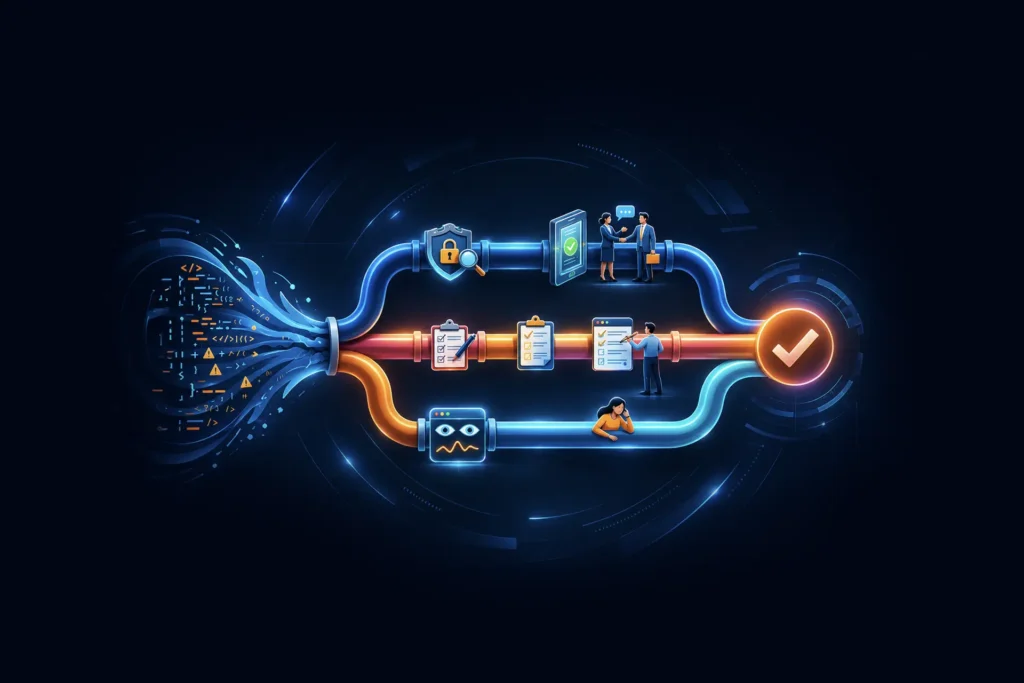
We divided the quality control process for AI-generated changes into three levels.
1. Validation
For each type of change, we defined a minimum set of checks: type checking, linting, builds, tests, and, for user interface changes, visual inspection.
The agent must clearly distinguish between checks that were run, passed, failed, or were not performed. If automated tests do not exist for the affected area, the agent must explicitly report this as a validation limitation.
After all, a successful build or type check does not necessarily mean the functionality works correctly. The final report must therefore describe what was validated and identify any risks that remain untested.
2. Workflow-Level Review
Before handing over its work, the agent must check the correctness of the solution, its consistency with existing project patterns, security considerations, edge cases, and whether it fully meets the original requirements.
3. Dedicated Code Review
The third level is a formalized code review performed through a dedicated project skill.
The review follows predefined rules and produces a structured assessment of the changes, supported by specific evidence.
To improve objectivity, it is advisable to separate implementation from review, for example by using a separate agent or an independent working context. Automated code review complements developer review rather than automatically replacing it.
Project Skills: A Defined Process for Different Types of Tasks
Not every development task requires the same approach. That’s why we introduced project skills into the workspace: formalized procedures for recurring types of tasks.
We manage these skills through a central registry. Each skill has a defined purpose, conditions for when it should be used, and situations in which it should not be applied.
Checking the skill registry is a mandatory part of the workflow. Before starting each task, the agent checks the request against the registry. If a relevant skill is available, it loads the skill definition and follows its instructions. The agent then specifies which skill it used in its final report.
So far, we have implemented two project skills:
1. Code review
The code review skill evaluates changes against a specified target branch of the repository, usually its default branch.
The review is performed strictly in read-only mode. During the review, the agent must not modify source code or project configuration.
Where the technical environment supports it, read-only restrictions should also be enforced through permissions rather than relying solely on project instructions.
The agent classifies identified issues by severity and must provide evidence for every finding. The review ends with one of three verdicts: Pass, Fail, or Unable to Assess.
2. Problem Analysis
The second skill is designed to analyze a bug or development request before implementation begins. Here, too, the agent works in read-only mode. Its responsibility is to prepare an analysis document, not to modify code or configuration.
Each analysis follows a predefined template and includes a timestamp in its filename.
The document identifies affected files, proposed changes, risks, and open questions. It also separates verified facts from hypotheses and assigns a confidence level to its conclusions: confirmed, probable, possible, or disproven.
A human then reviews, revises, or approves the analysis. Only after that can it serve as the basis for implementation.
These analyses are temporary working documents, so we do not normally include them in version-controlled project documentation. However, if an analysis leads to a significant technical or architectural decision, we record the outcome in the appropriate permanent documentation or project memory.
This allows us to keep temporary working materials separate from project knowledge that remains relevant over time.
Project Memory: Preserving Knowledge Across AI Agent Sessions
Within the shared workspace, we introduced project memory to preserve information that cannot be inferred directly from source code. This includes internal conventions, technical decisions, constraints, known issues, and details specific to the development environment.
Project memory is version-controlled in Git alongside the project instructions. It is not stored in a user’s personal settings or tied to a specific AI tool, making it available to the entire team and all supported agents.
Every memory entry follows a consistent structure: information type, date, fact, rationale, and instructions on how to apply it.
The memory also includes an index that identifies when each entry is relevant. The agent reads this index before every task.
New information is added to project memory only after human confirmation, a duplicate check, and verification that it is appropriate to share.
Credentials, access tokens, secrets, and other sensitive information that should not be stored in a shared, version-controlled environment must never be added to project memory.
Outdated entries are updated or removed. When architecture or project rules change, we also need to check whether existing memory entries are affected.
Personal preferences and the status of ongoing tasks do not belong in project memory. This approach keeps important project knowledge available across sessions and throughout the development team.
AI Agents Bring New Opportunities and New Responsibilities
AI agents can take over certain development tasks, speed up problem analysis, and make working with code more efficient. But the more autonomy we give them, the more important it becomes to understand its limits.
That’s why, when developing software for our client, our priority wasn’t to maximize autonomy. Instead, we focused on clearly defined rules, reliable quality checks, and human involvement in critical decisions.
The key takeaway? Knowing what an AI agent can do isn’t enough. We also need to know when it can work independently, how its results will be verified, and when a human needs to take over the decision-making process.
Need Help Integrating AI Agents into Your Development Process?
We can help you prepare your development environment, establish clear rules for working with AI agents, and find the right balance between automation and control.
Arrange a Consultation