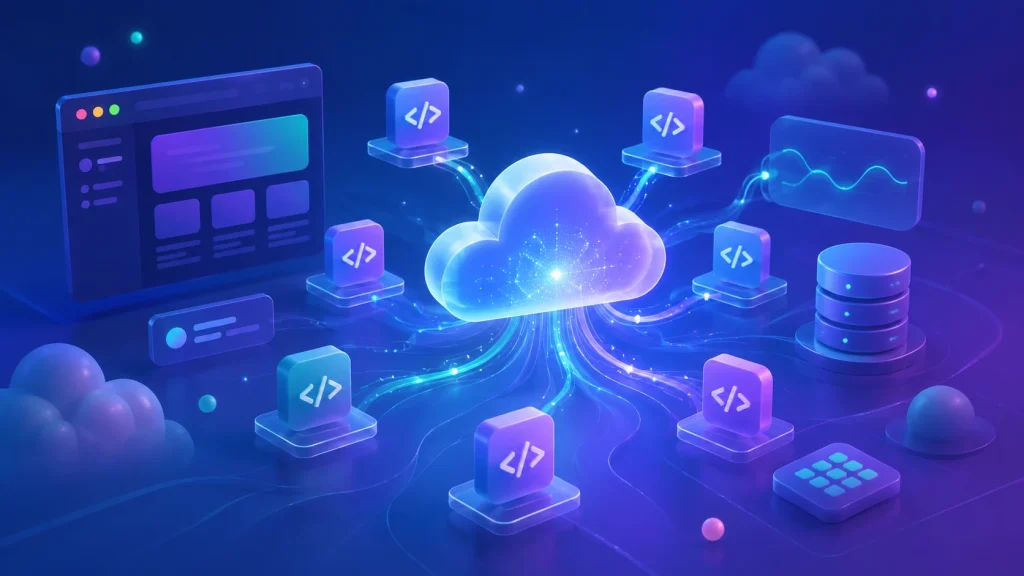
Despite the name, “serverless” does not mean there are no servers. There are always servers. It just means that your team don’t need to manage them directly. A platform such as AWS, Google Cloud, Azure, Vercel, Netlify, Cloudflare, Firebase, or Supabase takes over more of the infrastructure work, and you focus more on product logic. It changes how fast you can ship, what you pay, how you debug, and the kinds of mistakes you can make. The shift, from owning infrastructure to renting capability, is what this article is about.
Serverless functions vs long-running backend
The most visible piece of serverless is a serverless function: a small chunk of backend code that runs only when something triggers it, then disappears. That trigger could be an HTTP request, a webhook from Stripe, GitHub, a scheduled cron job, a message from a queue, or even a route in a frameworks like Next.js living right alongside your frontend.
One can do a surprising amount with serverless functions, but they are not a one-to-one replacement for a long-running backend service.
| Traditional backend | Serverless function | |
| Lifecycle | Always on | Spun up on demand, then torn down |
| State | Keeps things in memory | Stateless between invocations |
| Connections | Holds persistent ones | Reconnects each time |
| Scaling | You provision it | The platform handles it |
| Best at | Continuous, stateful work | Short tasks with clear input and output |
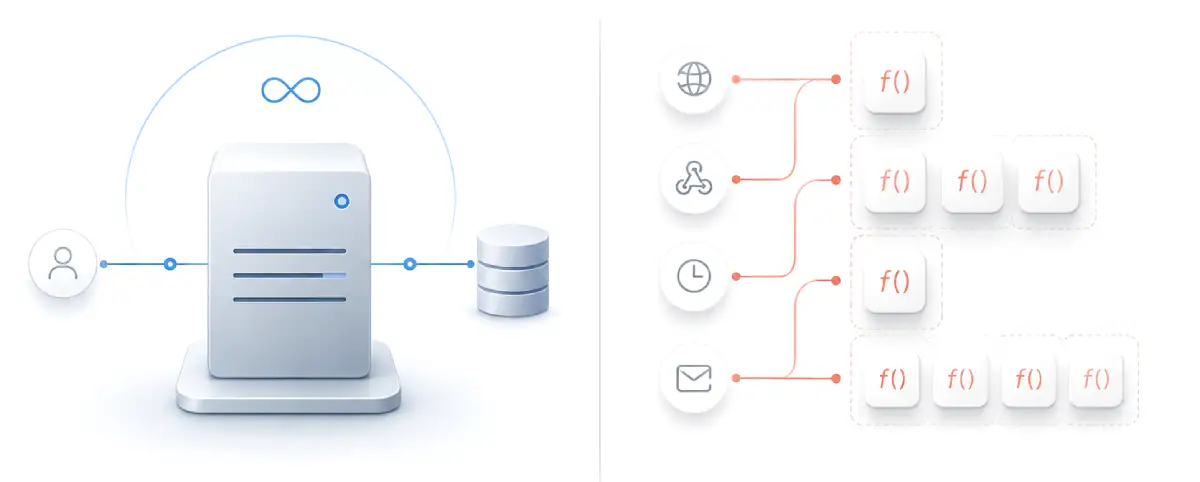
That makes functions excellent for work with a beginning and an end: validate a request, send an email, resize an image, process a payment webhook, generate a PDF, or just call an AI model without leaking your API key to the browser. It makes them less natural for workloads that need persistent processes, heavy computation, long-running jobs, two-way communication, or always-on in-memory state.
It's more than functions
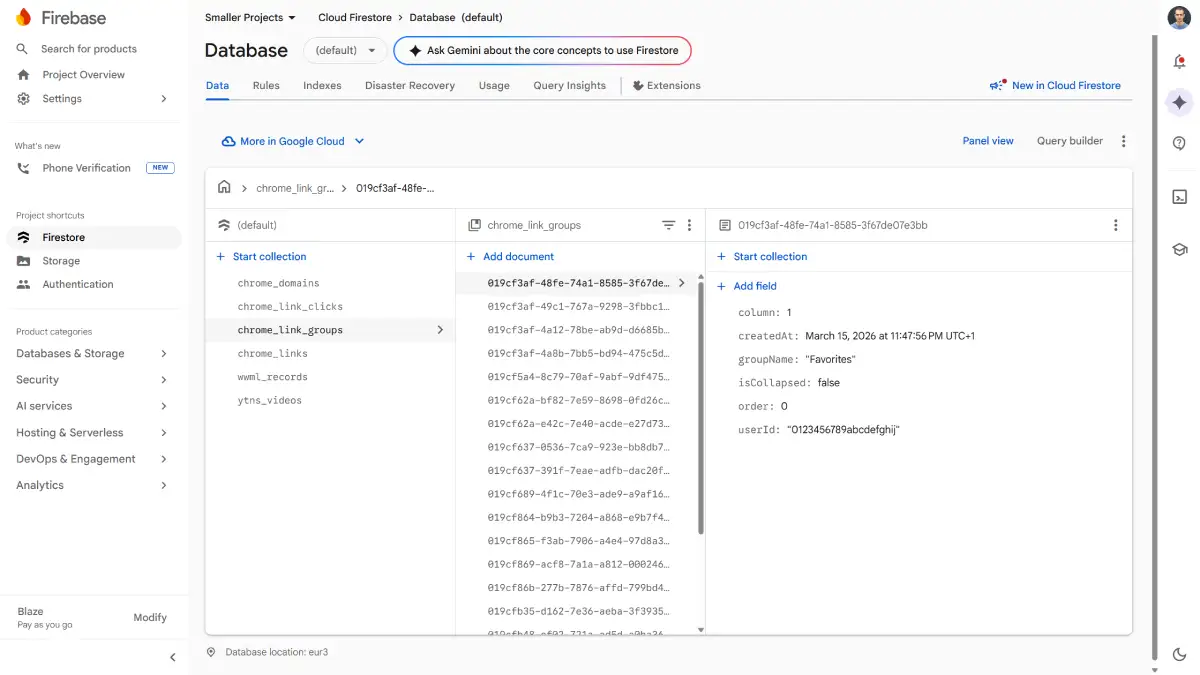
Serverless functions are one of the most essential building blocks, but serverless is more than just functions. A modern serverless app is often a composition of different managed services you wire together instead of building yourself. The full set of building blocks includes:
- Functions – the on-demand backend code we just covered.
- Databases – both SQL (usually Postgres-based, like Supabase or Neon) and NoSQL (document stores like Firestore or DynamoDB).
- Hosting & CDN – your frontend served globally, with previews and edge caching baked in.
- File storage – object storage for uploads, assets, and backups (S3, Cloudflare R2, Firebase / Supabase Storage).
- Queues & event systems – for work that should happen later, in the background, or after another service emits an event.
- Authentication – sign-in, sessions, and social providers in a few clicks (Clerk, Auth0, Firebase / Supabase Auth).
- Specialized APIs – search, analytics, email, AI APIs, push notifications, remote config – any managed service you just use instead of building it.
For a small team, this is close to a superpower. A two-person team can ship a product with authentication, database, file uploads, transactional emails, background jobs, preview deployments, global hosting, and automatic scaling without hiring a dedicated infrastructure team. A decade ago this would have been impossible.
So what does this unlock?
Serverless shines brightest when your app is client-heavy and the backend mostly guards secrets, validates input, coordinates services, and handles the occasional privileged task. A huge slice of modern software fits that shape: SaaS dashboards, internal tools, e-commerce flows, AI-assisted apps, mobile backends, and prototypes that quietly grow into real products.
In such use cases, the practical benefits are hard to ignore:
- Fast deployment – push code, get a preview URL, test before you merge.
- Cheap, often free, at low traffic – most projects pay nothing meaningful until people actually show up.
- Scaling is someone else’s problem – a traffic spike doesn’t require manual server provisioning.
- Smaller operational burden – fewer machines, runtimes, and patches between you and production.
- Clean isolation – webhooks, cron jobs, and AI calls live in small, focused units instead of bloating a monolith.
- Faster experimentation – teams can validate product ideas before building a full backend platform.
This is why serverless feels almost unfair for early-stage products. It lets you start with production-grade building blocks instead of spending the first month assembling plumbing.

How to choose a platform
The right platform choice starts with the shape of your app. Some apps need a robust database and tight backend control, while others just need the simplest path from code to production.
- Vercel – the smoothest path for Next.js and frontend-heavy apps. Excellent DX and previews, but costs climb as you scale.
- Netlify – delightfully easy to get started, though it quietly cut its free-tier limits for new accounts recently.
- Cloudflare – an edge-first toolkit that goes well beyond Pages: Workers, R2 storage, DNS, CDN, bot protection, tunnels.
- Firebase – a fast, beginner-friendly bundle of services around the document-based Firestore. Reliable multi-provider auth in a few clicks, and a generous free tier.
- Supabase – built around a real Postgres database. Robust, lots of options, a natural home for relational, SQL-centered products.
- AWS, Google Cloud, Azure – the deepest building blocks and the most power, at the cost of more configuration and more decisions. Best when you’re building something complex or enterprise-grade.
Once a platform looks like a fit, check the practical constraints: runtime support, timeout and memory limits, local development, observability, database connection behavior under concurrency, and budget controls. The answer can also be a combination of platforms, such as Netlify + Firebase, if that fits the app better.
Things to keep in mind
While serverless simplifies a lot, the complexity doesn’t vanish. It just moves into the contracts between services. For that reason, the architecture and choices still matter.
- Architecture can fragment – serverless makes it easy to create many tiny functions. Without clear boundaries, naming, ownership, and shared conventions, the backend becomes a drawer full of cloud scripts instead of a single coherent application.
- Debugging can get harder – a local monolith is often easier to inspect than a distributed set of functions, queues, webhooks, and managed APIs.
- Execution limits – functions often have caps on duration, memory, payload size, and concurrent connections. A payment webhook is a great fit, but waiting on a response from a long-running LLM agent would probably need more than a single function call.
- Cold starts – some platforms need to “wake up” a function before running it. It may be irrelevant for background tasks, but it can add some latency for user-facing endpoints where every millisecond matters.
- Cost predictability – serverless pricing often combines invocations, compute time, bandwidth, storage, database operations, etc. Therefore, the costs might be hard to predict exactly, and while starting cheap, or even free, it can get expensive on heavy traffic or suboptimal communication patterns. Budgets and alerts are critical.
- Vendor lock-in – building directly on Cloudflare Workers, Firebase, or Vercel can make you faster but also more platform-dependent.
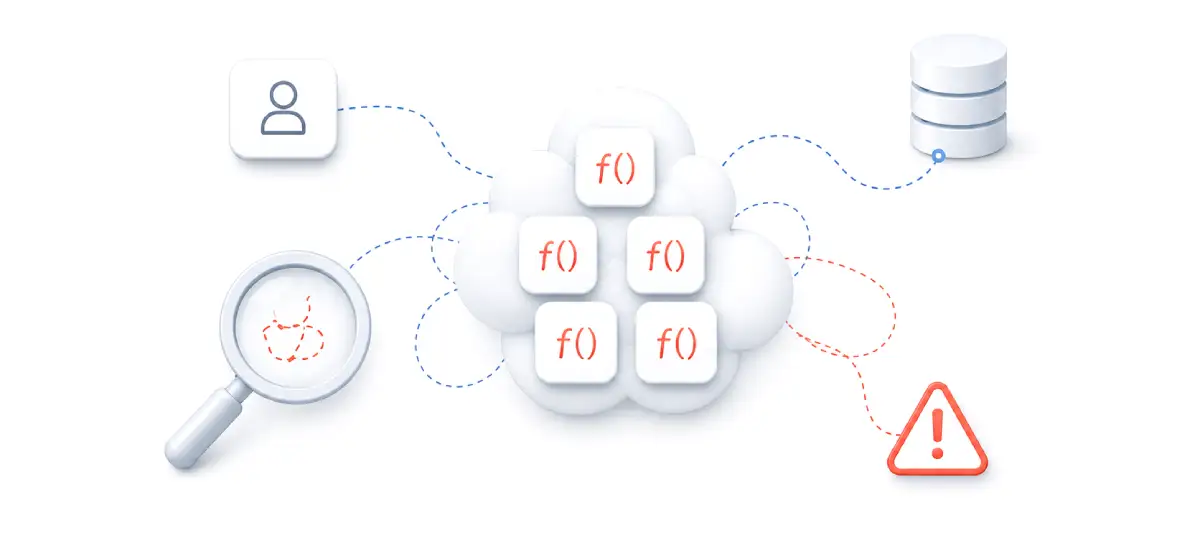
Serverless gives you speed, elasticity, and less operational surface area. In return, you accept platform constraints, different debugging habits, less control over runtime details, and sometimes less predictable costs. The question is not whether serverless is “better” than a traditional backend. The better question is: Which parts of this system are worth owning, and which parts should we rent?