AI in SAP is becoming increasingly important as artificial intelligence transforms the way businesses use SAP solutions. From AI assistants and business process automation to AI-powered e-commerce features, the possibilities continue to expand.
How far has SAP come with AI, and what does this mean for companies already using its solutions?
In this article, we explore the latest AI developments, practical applications in SAP Commerce Cloud and SAP S/4HANA, and what businesses should consider when planning the future of their SAP landscape.
AI Adoption Is Growing, but Companies Still Lack Hands-On Experience
According to the SAP LeanIX Agentic AI Survey 2026, AI agents are becoming increasingly common in enterprise environments. The survey highlights several interesting findings. Most respondents are already using or exploring AI to some extent, yet more than half report a lack of technical know-how and practical experience. A significant proportion also say they lack visibility into AI compliance, performance, and return on investment.
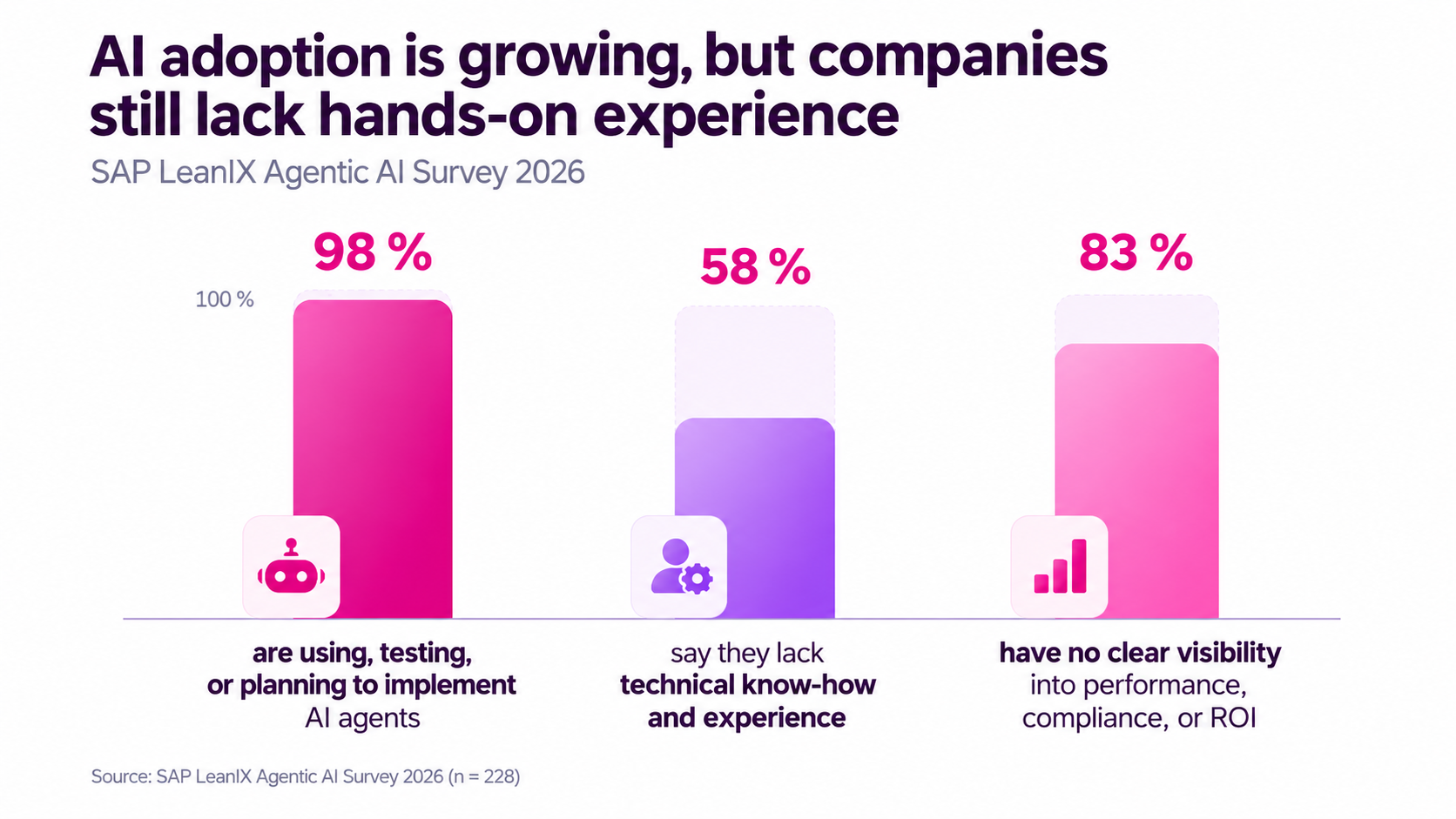
Conducted among enterprise architecture and IT professionals from 228 companies, the survey highlights an important distinction: implementing AI is one thing, but using it effectively, managing it, and measuring its business impact is another.
For companies operating complex SAP environments, this makes well-designed system architecture, reliable integrations, and the modernization of existing solutions increasingly important.
SAP Business AI and Joule: How Is AI Transforming the SAP Ecosystem?
SAP is gradually introducing AI capabilities across different parts of its ecosystem. Artificial intelligence is becoming an integral part of enterprise applications and employees’ everyday workflows.
One of the key developments is SAP Business AI. Rather than a single product, it is an umbrella term for the AI capabilities and technologies SAP integrates into its enterprise solutions, including SAP S/4HANA, SAP SuccessFactors, SAP Ariba, and SAP Commerce Cloud. These capabilities help businesses automate processes, work more efficiently with data, and simplify everyday tasks.
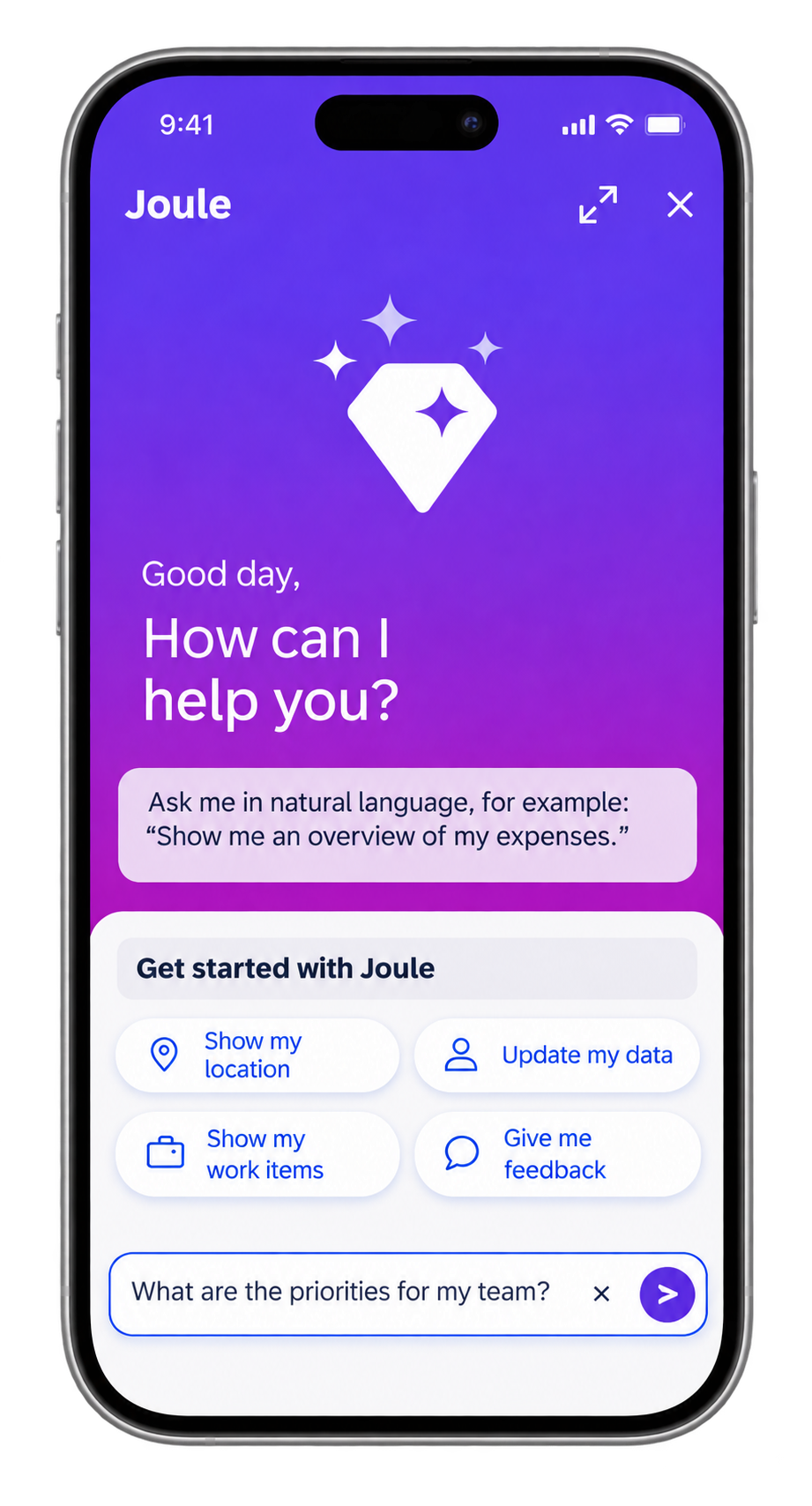
Like many major enterprise software providers, SAP has also introduced its own AI assistant. SAP Joule enables users to interact with supported SAP applications more naturally, for example, by asking questions in everyday language instead of navigating multiple screens and transactions.
What Does This Look Like in Practice?
The possibilities vary depending on the SAP solution and business area:
- Finance: Assistance with invoice processing, financial data analysis, and identifying discrepancies.
- Procurement: Streamlining purchasing processes, accessing supplier information, and supporting decision-making.
- Human Resources: Helping create job descriptions, identify suitable candidates, and handle administrative tasks.
- E-commerce: Generating product descriptions, enriching product catalogs, and enabling more intelligent product search.
For businesses, however, the key question is not just which AI features SAP offers, but which ones they can actually use within their existing environment.
This depends on the SAP solutions they use, data quality, existing integrations, and overall technical readiness. These factors often determine whether AI remains an interesting new feature or delivers real business value.
SAP already offers a wide range of AI capabilities across its products. If you want to explore which features are available for your specific SAP solution, the SAP Business AI Catalog is a good place to start.
AI in SAP Commerce Cloud: Standard Features or Custom Development?
One area where artificial intelligence already has practical applications is SAP Commerce Cloud.
SAP continues to expand its AI capabilities in e-commerce, including through the SAP CX AI Toolkit. It offers features that can help businesses simplify product content management and make everyday operations more efficient.
But what happens when SAP’s standard features don’t fully meet a company’s specific requirements?
Especially in more complex B2B and B2C environments, there is often a need for custom AI development and integration with SAP Commerce Cloud.
Potential use cases include:
- AI assistants and agents: Helping customers choose products, check order statuses, or resolve inquiries.
- Intelligent search: Enabling customers to find products using natural language, technical specifications, or specific requirements.
- Product catalog automation: Generating, enriching, and updating product information.
- Internal process automation: Connecting AI with ERP, CRM, PIM, or warehouse systems to support order processing, customer requests, or returns and complaints.
In these scenarios, the AI itself is only part of the solution. What matters just as much is how it connects to existing systems.
For example, if an AI agent is expected to provide customers with real-time order information or perform a specific action, it needs reliable access to data and functionality across the relevant applications.
We explored this topic in more detail in our previous article: AI Agents (Not Only) in E-commerce: Why Integration Matters More Than the Model Itself.
SAP S/4HANA Migration: How Can AI Help?
Artificial intelligence is finding its place not only within SAP applications but also in their modernization.
AI can already support migrations from SAP ECC to SAP S/4HANA, particularly when it comes to analyzing and adapting existing code.
For example, SAP has introduced the SAP S/4HANA Custom Code Migration Agent, an AI-powered tool designed to assist developers with migrating custom ABAP developments.
What does this mean in practice?
- Analyzing existing ABAP code: AI helps identify code that is incompatible with SAP S/4HANA and explains why changes are needed.
- Suggesting code modifications: Based on analysis results, AI can recommend specific changes and automatically implement fixes for selected issues.
- Supporting testing: AI tools for ABAP development can help generate unit tests, which developers can then review and use to validate changes.
These capabilities can reduce manual effort during technical migrations, particularly for companies with extensive SAP customizations.
However, AI does not replace experienced SAP consultants.
A successful migration still requires a thorough assessment of the existing environment, decisions about the target architecture, integration adjustments, and comprehensive testing of business processes.
At Cassovia Code, we work with SAP consultants who specialize in S/4HANA migrations. Combined with our expertise in SAP development, Fiori, BTP, and system integrations, we can help companies modernize their SAP environments.
An S/4HANA migration can therefore be more than a move to a modern ERP system. It can also be an opportunity to prepare for broader AI adoption in the future.
SAP BTP and AI: When Standard Features Are Not Enough
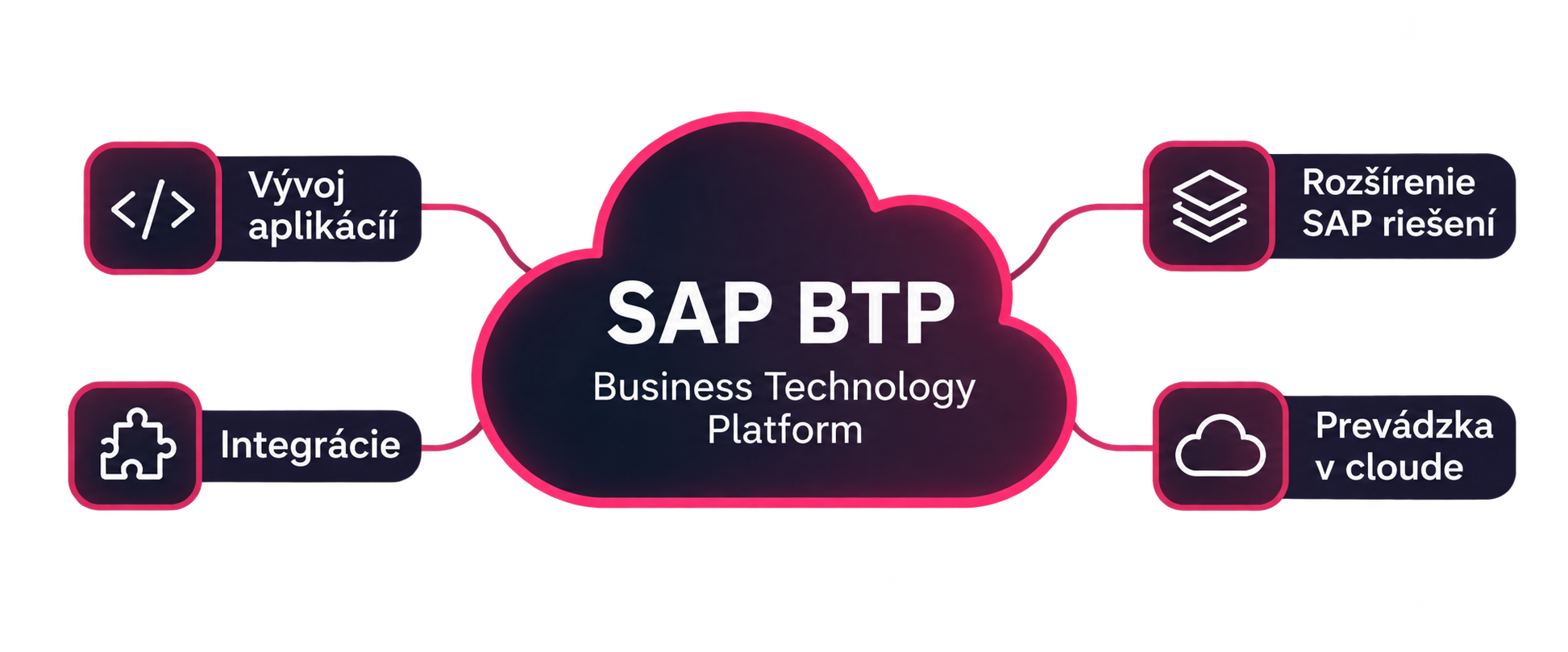
When discussing AI in SAP, SAP Business Technology Platform (BTP) is another important part of the picture.
Beyond application development and system integration, SAP BTP provides technologies for building custom AI solutions.
Through SAP AI Core and the generative AI hub, developers can work with different AI models and connect them to enterprise applications. SAP HANA Cloud also provides capabilities for making relevant business data available to AI-powered applications.
What does this look like in practice?
Imagine a company developing its own AI assistant. Instead of simply answering general questions, the assistant could securely connect to SAP Commerce Cloud or an ERP system to check product availability, retrieve order statuses, or access other relevant business information.
SAP BTP opens up opportunities to develop tailored AI solutions when standard SAP functionality does not fully meet a company’s needs.
Reliable integrations, high-quality data, and well-designed architecture remain essential to making these solutions work.
The Future of AI in SAP Starts with the Right Foundations
Artificial intelligence is opening up new opportunities across the SAP ecosystem. However, simply introducing new tools does not guarantee success.
As the SAP LeanIX survey also highlights, many companies still lack the technical expertise and clear processes needed to measure the impact of AI.
For businesses using SAP Commerce Cloud, AI offers opportunities to streamline e-commerce operations and improve customer experiences. For companies preparing an SAP S/4HANA migration, building a modern and flexible technology landscape is an important step toward future innovation.
At Cassovia Code, we help companies develop, integrate, and modernize their SAP solutions. We combine practical AI experience in SAP Commerce Cloud with specialized SAP S/4HANA migration consultants and expertise across other SAP technologies.
Planning to enhance your SAP Commerce Cloud solution or migrate to SAP S/4HANA?
Get in touch!