What Does Open Source Mean in a Business Environment?
An open-source solution can be a complete business platform, a database, an integration tool, a content management system, a cloud technology, or a framework used to build business applications.
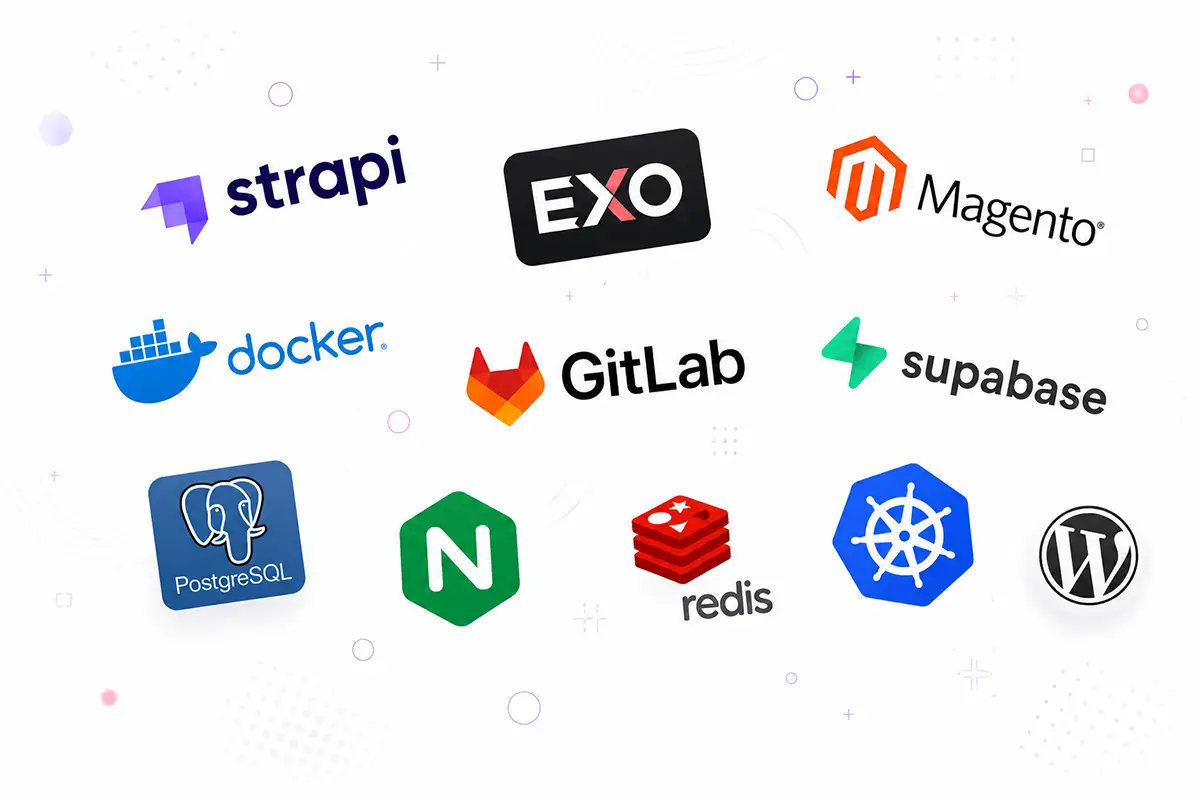
In practice, companies encounter open source in platforms such as Magento, content management systems such as WordPress, and modern headless solutions such as Strapi. Each serves a different purpose, but they all offer opportunities for customization, greater control over the technology, and more freedom when building integrations.
A company can:
- run the solution on its own infrastructure,
- deploy it in a public or private cloud,
- manage it through an internal team,
- entrust it to a technology partner,
- or use it as a paid managed service.
Open source does not mean that a company is left without support or has to manage everything on its own. Businesses can still use commercial support, service-level agreements, or the services of a specialized technology partner.
The main difference is that they have more options when deciding how the technology will be operated, developed, and changed over time.
What Benefits Does Open Source Offer Businesses?
1. Greater Flexibility
One of the greatest advantages of open source is the ability to adapt a platform to specific processes, integrations, and business goals.
With proprietary solutions, a company is often limited by the features and product roadmap provided by the vendor. If a particular capability is missing, the company may have to wait for it to be added or find a workaround.
With open source, a business can build its own extension, modify the way the system behaves, or connect the solution to internal applications.
This is particularly valuable in projects where an off-the-shelf platform cannot cover all of the company’s requirements.
2. Less Dependence on a Single Vendor
With a commercial platform, a company may become dependent on one vendor’s pricing, licensing terms, product strategy, and business decisions.
Open source usually provides more freedom. A company can:
- change implementation partners,
- move the solution to another cloud provider,
- bring part of the development in-house,
- choose a different support model,
- continue developing the solution even if the original vendor changes direction.
This does not necessarily eliminate dependency altogether. However, it gives the business more options when responding to changes in pricing, terms, or the technical direction of the platform.
3. Greater Control Over Technology and Data
Open source gives companies more control over where a solution runs, how it processes data, and who has access to its technical workings.
This can be particularly important when dealing with:
- sensitive business data,
- regulated industries,
- data residency requirements,
- security audits,
- the need to operate the solution on the company’s own infrastructure.
A business can choose whether to deploy the platform in its own data center, a private cloud, a public cloud, or through a managed service.
4. Potentially Lower Licensing Costs
Many open-source platforms do not use traditional licensing models based on the number of users, servers, or transactions.
This can be especially beneficial for large-scale deployments, businesses with a high number of users, or companies experiencing rapid growth.
The company can then invest more of its budget in:
- customer-facing features,
- integrations,
- user experience,
- automation,
- security,
- the continued development of the platform.
Lower licensing costs do not mean zero costs. Open source should always be assessed based on the total cost of the solution throughout its entire lifecycle.
5. Easier Integrations
Companies rarely rely on a single system. A business platform often needs to connect with accounting software, warehouse systems, CRM platforms, analytics tools, payment services, or custom internal applications.
Open-source solutions are often well suited to environments where integrations are a key part of the project.
Access to the source code and open interfaces makes it easier to adapt the way systems communicate and reduces the number of technical limitations.
6. Better Opportunities for Long-Term Development
Open source can be a strong choice for companies that do not want to use a platform only in its standard form, but plan to expand it gradually.
The solution can grow with the business, adapt to new processes, and respond to new commercial opportunities.
Greater flexibility means that the company does not necessarily need to replace the entire platform every time its requirements change.
7. Transparency
Access to the source code makes it easier to examine how a solution works, how it processes data, and how it handles security.
The company does not have to rely solely on the vendor’s claims. It can have the code reviewed, carry out a security audit, or verify specific technical behavior.
Transparency does not guarantee security on its own, but it gives the company more options for assessing and managing it.
What Challenges Does Open Source Bring?
Open source offers many advantages, but greater control also comes with greater responsibility. These challenges are not necessarily reasons to reject open source, but they should be considered from the beginning of the project.
1. The Need for Technical Expertise
An open-source solution still needs to be designed, deployed, updated, and operated over the long term.
A company therefore needs:
- an experienced internal team,
- a reliable technology partner,
- or a combination of both.
Without the right expertise, operating the platform can become demanding. With the right team, however, a company can take advantage of open source without having to build and manage everything on its own.
2. Costs Shift to Other Areas
Open source may reduce licensing fees, but businesses still need to account for the cost of:
- implementation,
- custom development,
- hosting,
- monitoring,
- security,
- testing,
- technical support,
- updates.
This does not mean that open source is more expensive. It means that its cost structure is different.
The company spends less on the right to use the software and invests more in operations, quality, and the continued development of its own solution.
3. Support Must Be Set Up Properly
The community can be a valuable source of documentation and solutions to common problems. However, for a business-critical system, a company needs clearly defined support and ownership.
Suitable options may include:
- paid vendor support,
- a service-level agreement,
- an internal team,
- a technology partner with an agreed SLA.
Open source and professional support are not mutually exclusive. Many companies combine open technology with commercial services.
4. Updates Require Discipline
The more a platform is customized, the more important good architecture and regular updates become.
Problems usually arise when a company makes extensive changes to the core system without documentation or a long-term plan.
The risk of difficult upgrades can be reduced by:
- keeping customizations separate from the platform core,
- introducing automated testing,
- carrying out updates regularly,
- designing the architecture for future development.
The challenge is therefore not open source itself, but the way the solution is designed and managed.
5. Not Every Project Is Suitable for Business Use
Open-source projects vary significantly in quality, community size, and level of support.
Before selecting a platform, a company should check:
- how frequently new versions are released,
- whether security vulnerabilities are fixed regularly,
- the quality of the documentation,
- how many specialists are available on the market,
- whether the project has an active community,
- whether commercial support is available.
A well-chosen and actively maintained project can provide a stable foundation for many years. A poorly maintained solution, on the other hand, may create unnecessary risk.
6. Licenses Need to Be Reviewed
Open source does not mean that businesses can use software without restrictions.
Every project has a license that defines the conditions for its use, modification, and distribution. Some licenses are highly permissive, while others introduce additional obligations.
For business projects, it is therefore important to maintain an overview of the components being used and the licensing terms that apply to them.
Open Source or a Commercial Platform?
Both models can be suitable. The main difference lies in where the company wants to retain control and what it wants to pay for.
Area | Open Source | Commercial Platform |
Licensing costs | Often lower | Usually higher |
Customization | Highly flexible | Limited by the vendor |
Control over technology | High | Lower |
Technical support | Partner, internal team, or paid support | Official vendor support |
Vendor dependency | Usually lower | Usually higher |
Operations | More options, but greater responsibility | The vendor takes on part of the responsibility |
Integrations | Highly flexible | Depend on the available interfaces |
Updates | The company has more control over timing | Managed by the vendor |
A commercial platform may be a better choice when the main priorities are rapid deployment, standard features, and transferring a larger share of responsibility to the vendor.
Open source is particularly attractive when a company needs flexibility, wants to retain control over its technology, and plans to develop the solution over the long term.
In practice, the two approaches are often combined. A commercial platform may use open-source databases, integration tools, or frameworks. An open-source solution can also be delivered as a paid managed service.
When Is Open Source a Good Choice for a Business?
Open source may be a strong option when a company:
- requires a high degree of customization,
- wants control over its data and infrastructure,
- needs complex integrations,
- plans to develop the solution over the long term,
- wants to reduce dependence on a single vendor,
- expects growth in the number of users or transactions,
- has an internal technical team or a reliable technology partner.
When Might a Commercial Platform Be More Suitable?
A commercial solution may make more sense when a company:
- needs rapid deployment without significant customization,
- prefers ready-made business features,
- does not have an internal technical team or technology partner,
- wants support and operations covered by a single contract,
- requires specific certifications or guaranteed service levels.
Even in these cases, the solution does not have to be entirely proprietary. Many modern platforms combine commercial services with open-source technologies.
Is Open Source the Right Choice for Your Business?
Ask yourself the following questions:
- Do you need to adapt the platform significantly to your own processes?
- Do you want greater control over the technology, data, and operating model?
- Do you want to reduce your dependence on a single vendor?
- Do you need to connect the solution to multiple internal or external systems?
- Do you expect the platform to evolve or scale significantly in the future?
- Is it important for you to be able to change vendors, cloud providers, or operating models?
If you answered yes to at least three of these questions, open source may be an attractive option for your business.
Before making a decision, however, consider two practical requirements:
- Do you have an internal technical team or a reliable technology partner?
- Are you prepared to manage updates, security, and maintenance over the long term?
If the answer to both is yes, you have a strong foundation for the successful implementation of an open-source solution.
Conclusion
Open source can give businesses greater flexibility, more control over technology and data, easier integrations, and less dependence on a single vendor.
Its greatest advantage is not simply a lower licensing cost. More importantly, it gives companies the freedom to decide how their platform will be operated, developed, and adapted as their needs change.
At the same time, open source requires strong technical expertise, regular maintenance, and a clearly defined support model. These challenges are manageable when the company has an experienced team or a reliable partner.
For businesses that see their digital platform as a long-term part of their strategy, open source can be a powerful and strategically valuable choice.
Frequently Asked Questions
Is Open-Source Software Free?
Is Open Source Secure?
Yes, it can be secure when the project has an active community, regular updates, and a properly managed operating environment. Security depends mainly on the quality of the project and how it is maintained.
Is Open Source Suitable for Large Companies?
Yes. Open-source technologies are widely used in large-scale business systems. The key requirements are strong architecture, reliable support, and regular maintenance.
What Is the Main Difference Between Open Source and a Commercial Platform?
Open source offers greater control, flexibility, and customization options. A commercial platform usually provides a more ready-made solution and transfers a larger share of responsibility to the vendor.
Does Open Source Reduce Vendor Dependency?
Yes. A company usually has more options to change its implementation partner, operating model, or technical support provider. Dependency may not disappear completely, but it becomes significantly easier to manage.